Ring Design
The most obvious variation between different engagement rings, even more obvious than the shape and size of the diamond, is the type of setting. The key things to look at are the type of setting and also how the diamond(s) is/are attached to the ring. On this page I'll take you through a number of different ring designs with photos. I've included some of my picks for ring designs in the photos, which you can click on to see in more detail.
Sponsored Links
Solitaire Settings
|
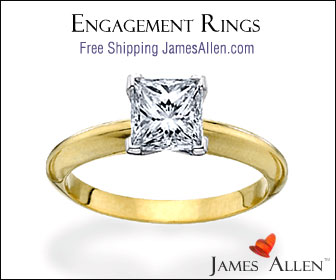
A solitaire setting has a single main diamond in the center of the ring in 'prime' position. Usually the diamond is a round or princess cut but anything goes. Solitaires are simple and elegant, but also put the most 'pressure' on the size of the center diamond because it's the one and only feature, as compared to say a three stone ring or ring with diamond channels (small diamonds along the band of the ring). If you like the look of a solitaire ring, click on the image to see what your options are for diamonds and design variations at JamesAllen.com |
Three Stone Settings
|
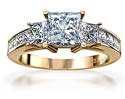
There are lots of different symbolisms given for having a three stone ring by jewellers. One of the most common is that one stone stands for the past, one stone stands for the present, and one stone stands for the future. A pragmatist may be more interested in the fact that you can cram on a whole lot more carat weight using three moderate sized stones, rather than one big one. For example, three one-third carat stones is a lot cheaper than a single full carat stone. But both have the same total diamond weight - one carat. Often the center stone is slightly bigger than the two side stones. For example, a ring might have a 0.37 carat center stone and two 0.2 carat side stones, for a total diamond weight of 0.77 carats. The side stones can also be different shapes, such as a pear shape. If you like the look of a three stone ring, click on the image to see what your options are for diamonds and design variations at JamesAllen.com |
Pave Settings
|
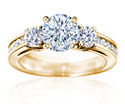
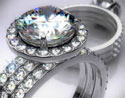
Pave diamond rings are an alternative to “big stone” diamond rings that can be attractive for a couple of reasons. A pave diamond setting is a ring which is covered all over with (smaller) diamonds. You literally cannot see much of the underlying ring at all. The name “pave” is associated with the French language and connects to how the diamonds are laid out a little like cobblestones on an old style road. For budget conscious people, you can get a “half pave” ring which only covers half of the ring with diamonds – which would be the upper half that is more visible than the bottom half, generally. There are also comfort considerations to think about. One (psychological) factor to consider with pave rings is worrying about the diamonds falling out. The small diamonds are generally more likely to fall out then well set solitaire rings, although many people with paves will have never had any problems. Almost a bigger concern than a diamond falling out is whether it’ll make you worry constantly - that sort of stress is not what you want with a diamond ring! If you’re looking to shake it up a little, you can get loosely paved diamond rings – which don’t have 100% coverage but rather scatter the diamonds around the surface of the ring – so you can see some ring and some diamonds. This is obviously cheaper and if you like the look, a great option to save some money. If you like the look of a pave diamond ring, click on the image to see what your options are for diamonds and design variations at JamesAllen.com |
Settings with Sidestones
|
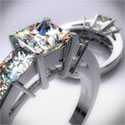
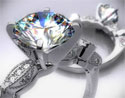
In-between three-stone rings and diamond channeling, there are many other types of multi-stone rings. For example, you might have 3 smaller diamonds on each side of a main diamond, for a total of 7 diamonds. These are settings with sidestones, and represent a slightly different choice if you would like to try something other than a solitaire or three-stone ring. If you like the look of a ring setting with sidestones, click on the image to see what your options are for diamonds and design variations at JamesAllen.com |
Rings with Channeling
|
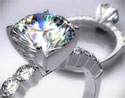
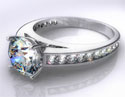
All rings can have diamond channeling or banding, where there are smaller diamonds inset into the band on either side of the main set of diamonds. These can help jazz up the appearance of the ring and also supplement the center diamond, if you can't afford to get a big one but want the ring to look showy. Often the inset diamonds are round or princess shape. One thing to be careful of with these rings is to not get deceived by the Total Diamond Weight (T.D.W.) quoted. For example, the ring at the left might have a tdw of 2 carats, but the center diamond might only be 1.3 carats, with 0.7 carats worth of smaller diamonds in the banding. If you like the look of a ring setting with channels, click on the image to see what your options are for diamonds and design variations at JamesAllen.com |
Tension Rings
|
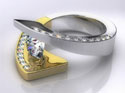
A tension ring is a ring where the whole ring is like a spring holding the diamond in position. This design means that there's usually no ring metal across the diamond, which in turn means more light can get into the diamond, making it sparkle more. It's especially important to go to a reputable seller for these types of rings, as an error in their creation may have catastrophic consequences. They are very beautiful and very unique rings. If you like the look of a tension ring, click on the image to see what your options are for diamonds and design variations at JamesAllen.com |
Four Prongs or Six?
|
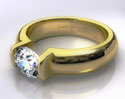
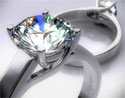
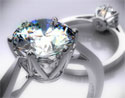
Typically the diamond is attached to the ring using either four prongs (such as the one on the left) or six prongs. Generally speaking, each prong in a four prong ring is slightly thicker than a prong in a six prong setting. However, overall, the four prong setting lets more light into the diamond (which is always a good thing), while the six prong is often a little more secure. A securely fastened diamond is especially desirable if the wearer of the ring is active in their everyday lives. One thing that should be pointed out is that a good jeweller can set a four prong diamond much more securely than a shoddy jeweller setting a diamond in a six prong setting. |
Get started designing your ring now at James Allen by clicking on the banner below: